
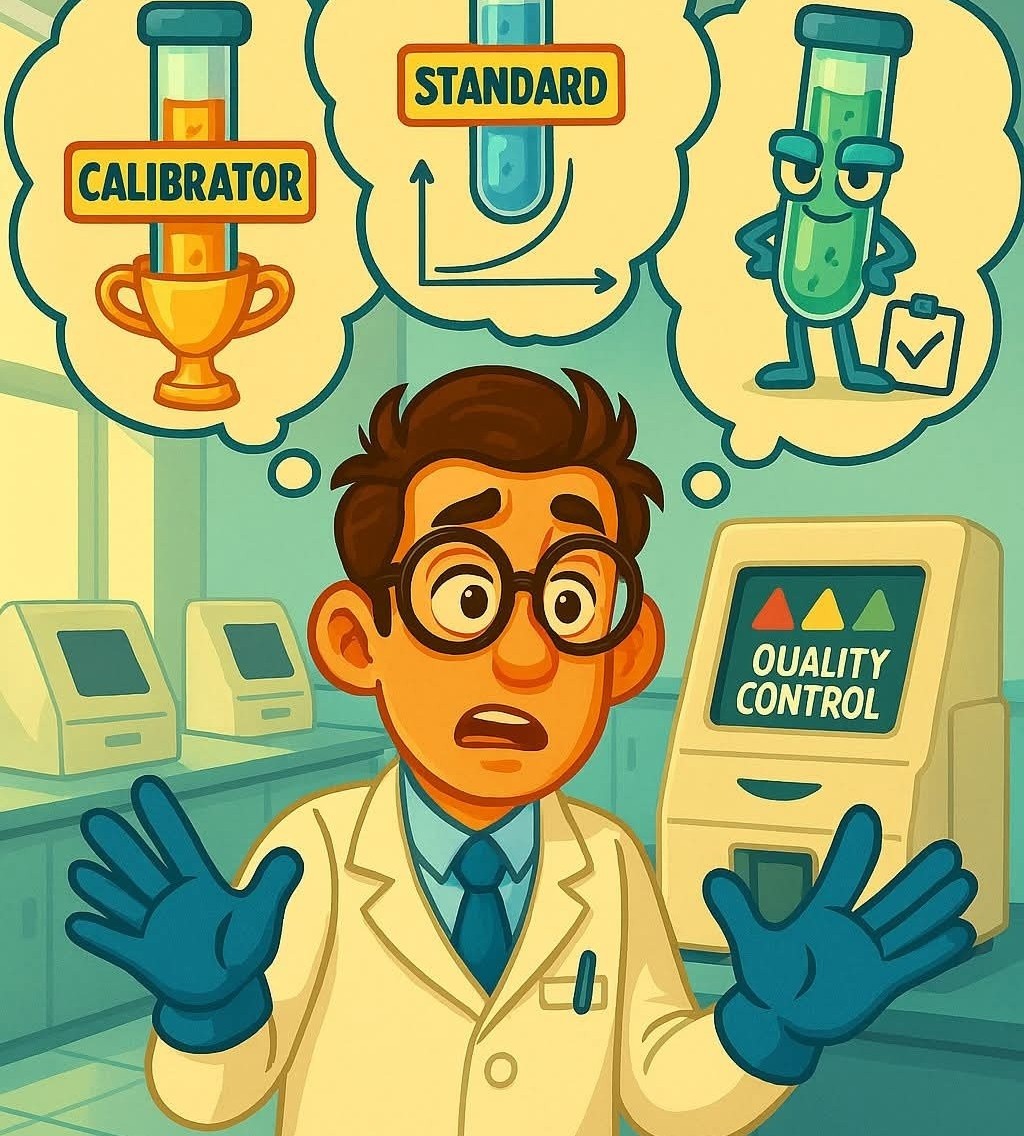
The Difference Between Calibrator, Standard and QC!
In the lab, you might see lots of tubes that look alike, all filled with liquids, and think they serve the same purpose.
But the truth?
Each one has a completely different role, and if you mix them up, the whole test can go wrong!
Calibrator, Standard, and Quality Control.
We’ll see how Beer’s Law connects them in what I like to call the “Correct Analysis Chain.”
First:
Calibrator – the teacher that trains the machine
The Calibrator is the material we use to adjust the machine before starting any test. It’s like telling the machine: “If you see this concentration, you must give this number!” Just like setting a clock to the official time, or zeroing a scale before weighing. If the machine isn’t properly calibrated, all subsequent tests will be wrong-even if you use excellent materials.
It’s the foundation everything else is built on.
Second:
Standard – the reference we measure against
The Standard is a material with a known concentration, but it’s not for calibration. It’s used during the analysis itself. We prepare different concentrations from it, measure the absorbance of each, and plot a Standard Curve.
Here comes Beer’s Law:
The higher the concentration, the higher the absorbance… provided the machine was calibrated correctly from the start.
So the Standard makes the law work in practice, not just theory. Without it, we can’t calculate unknown sample concentrations accurately.
Third:
Quality Control – the inspector watching the machine
QC is a material with a known concentration, used after calibration to check whether the machine is still working properly. It’s like asking the machine: “Are you still giving correct results, or have you started drifting?”
If the QC result falls outside the acceptable range, there’s a problem. It could be the machine, the calibration, or even the operating procedure. At that point, everything must be reviewed before continuing with patient samples.
Why is it important to know the difference?
Because if someone uses a Standard instead of a Calibrator, the machine won’t calibrate correctly and will start producing wrong results. And if someone uses QC as if it were a test material, the result will be inaccurate - and could harm the patient or client. Mixing them up doesn’t just ruin the test… it could ruin the lab’s reputation!
Bottom Line
Each of the three has a specific role:
- Calibrator adjusts the machine before testing.
- Standard is used during testing to calculate concentrations.
- QC monitors the machine after calibration to ensure everything is running correctly.
If we understand the difference, the lab runs with accuracy, speed, and reliable results.